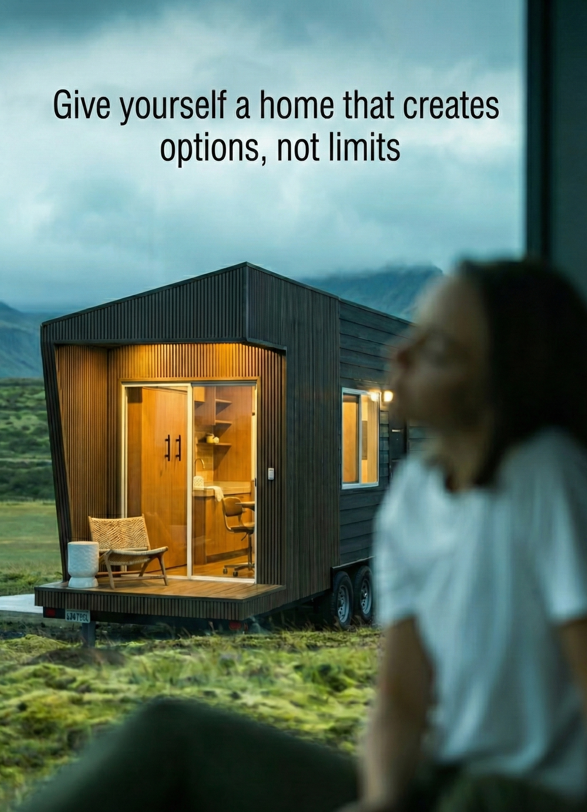
In 2025, tiny homes aren’t a quirky Pinterest trend anymore they’re a real part of the housing conversation. The global tiny home market is projected to keep growing steadily through the rest of this decade, driven by affordability pressures, sustainability goals, and a desire for more flexible living.
But the category is also getting crowded. There are $5,000 prefab “boxes” floating around online alongside six-figure, architect-designed tiny homes. Some are engineered like real homes. Some… are not.
That’s exactly where myHAUSING and Vettel Haus live: in the “tiny home, grown-up standards” camp. Let’s zoom out to what’s changing in 2025 and how Vettel Haus is designed to actually make sense in this new landscape.
1. Tiny homes have grown up
A decade ago, the tiny home movement was mostly about minimalism and cute lofts. Today it’s much more about math and long-term usability.
- Housing costs: Traditional housing is still out of reach for many buyers, with home prices and rents well above pre-pandemic levels. That’s pushing people to look seriously at alternative formats like tiny homes, ADUs, and modular units.
- Market maturity: Analysts now frame tiny homes as a defined niche category with steady, not speculative, growth—especially in North America.
- Use cases: They’re no longer just for off-grid dreamers. Buyers include remote workers, hospitality operators, downsizers, and homeowners looking for guest suites or rental income.
In other words: tiny homes have graduated from “experiment” to “alternative housing product.” The bar is higher.
2. What’s changing in 2025
a) Zoning and regulation are slowly catching up
Many local governments are revisiting zoning and code to allow more small-scale housing whether as tiny homes, ADUs, or village-style communities as they look for practical responses to affordability and housing shortages.
For buyers, that means:
- More paths to place a tiny home legally (as an ADU, guest house, or park-model/RV in approved settings).
- More scrutiny around safety, certifications, and who built the unit.
This is why myHAUSING leans so heavily on building to ANSI 119.5 RV standards and third-party inspection: it speaks directly to that new regulatory reality.
b) Remote work is making “where” more flexible
Remote and hybrid work are still reshaping housing demand. Many professionals are prioritizing quality of space over proximity to an office, looking for home offices, creative studios, and nature-adjacent locations instead of dense urban apartments.
A high-end tiny home on wheels like Vettel Haus plugs straight into that shift:
- As a standalone studio office on your property
- As a moveable base at a favorite RV park or resort
- As a content studio / remote work hideout that still feels like a boutique hotel
c) Costs are clearer and buyers are more skeptical
By 2025, a professionally built tiny home generally falls somewhere around $30,000 to $100,000+, depending on size, materials, and level of finish.
At the same time, online marketplaces are flooded with ultra-cheap prefab units. That’s created confusion:
- Why does one “tiny home” cost $25,000 and another $150,000?
- What’s the difference between a container, a shed, an RV, and a real tiny home designed for daily living?
The answer usually comes down to engineering, materials, certification, and layout the unglamorous stuff that determines whether a unit feels like a real home or a dressed-up box.
3. The 2025 buyer checklist: what people actually want now
Design trends in 2025 are leaning toward sustainability, smart systems, and multi-use spaces, especially in smaller homes. Think energy-efficient appliances, thoughtful storage, reclaimed or durable materials, and layouts that let one space work hard all day.
The modern tiny home buyer is asking:
- Is it engineered, or just pretty?
- Real framing, real insulation, real specs, real certification.
- Can I live / work in it comfortably, not just weekend in it?
- Natural light, decent ceiling height, proper kitchen and bath, real climate control.
- Will it function as an investment, not just an impulse purchase?
- Can I rent it on a property? Use it as an ADU-style guest suite? Redeploy it to another site later?
Vettel Haus was designed to tick those boxes, not just rack up “likes.”
4. Where Vettel Haus + myHAUSING stand out
Vettel Haus by myHAUSING is a luxury tiny home on wheels that’s built like a high-end studio, not a camping trailer:
- Built to ANSI 119.5 standards with third-party inspection, so there’s a clear compliance story.
- Plug-and-play utility design so you can be operational quickly in the right setting.
- Premium finishes SMEG fridge, Blanco fixtures, architectural lighting, custom cabinetry—because tiny doesn’t have to mean basic.
- Shape-shifting interior with a Murphy bed so the same footprint is your lounge, office, and bedroom depending on the time of day.
For owners, this positions Vettel Haus as a multi-role asset:
- A design-forward ADU-style guest house
- A bookable “tiny hotel” or Airbnb-style unit
- A remote office or creative studio that actually impresses clients on Zoom
- A short-term housing solution for staff, family, or life transitions
And because myHAUSING is obsessed with the details down to hinges, hardware, acoustics, and lighting you’re not just buying square footage; you’re buying a curated experience that photographs beautifully and lives even better.
5. Who Vettel Haus is ideal for in 2025
In the current 2025 landscape, Vettel Haus makes particular sense if you’re:
- A homeowner who wants a high-end guest suite or office instead of a basic shed or generic prefab.
- An investor or host building a tiny “micro-resort,” boutique glamping concept, or backyard rental unit that commands premium nightly rates.
- A professional creator or remote worker who wants a beautiful, quiet space to work, film, and host clients without leasing extra commercial space.
- A downsizer with high standards. You’re willing to go smaller, but you’re not willing to feel cramped or compromise on design.
In all of those cases, the question isn’t “Is a tiny home trendy?” but “Does this specific tiny home still make sense ten years from now?” In 2025, that comes down to build quality, flexibility, and brand.
6. Tiny homes in 2025: why the brand behind the box matters
As the market matures, the name on the data plate matters more. Buyers want:
- A traceable manufacturer instead of a mystery import
- Documentation on engineering, specs, and materials
- A team they can actually email or call when they have questions
myHAUSING is deliberately building that kind of brand around Vettel Haus and future models; design-led, detail-obsessed, and transparent about what’s included and why.
You’re not just getting a unit; you’re stepping into a company story that includes:
- Design collaboration with top-tier professionals
- Philanthropic commitments around housing and community
- A long-term vision for how tiny homes fit into North American housing, not just this year’s hype cycle
Ready to see if Vettel Haus fits your 2025 life?
If you’ve been tiny-home-curious but skeptical, that’s healthy. In 2025, the right move isn’t “buy any tiny home” it’s choose a tiny home that’s engineered, beautiful, and future-usable.
Vettel Haus was built for that exact sweet spot.